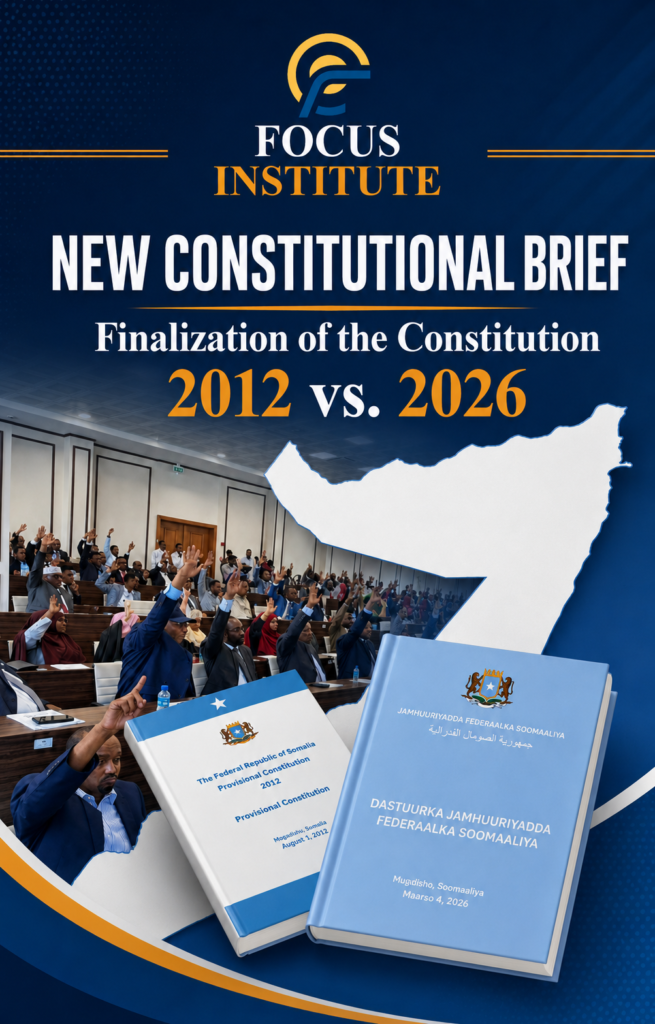
Somalia’s Constitution, Finalized: What Changes Under the 2026 Amendments
On March 4, 2026, Somalia’s Federal Parliament approved the final set of amendments to the Provisional Constitution covering Chapters 5 through 15 and building on the 2024 revisions to Chapters 1–4. After 14 years of review, the country has moved from a deliberately incomplete transitional charter to what a new Focus Institute brief calls a “codified, legal-institutional” constitutional order.
Here’s what actually changed, and why it matters.
The 2012 Provisional Constitution was built to be incomplete. Core issues resource-sharing, the shape of federal member states, the allocation of powers were deliberately left open for future negotiation, relying on informal elite bargaining to hold the country together after decades of conflict.
The 2026 amendments close most of those gaps. Every one of the 15 chapters now contains detailed, codified rules rather than placeholders. That trade-off cuts both ways: it gives Somalia legal predictability and a clearer roadmap for state-building, but critics warn the added rigidity could produce political paralysis in a country where legal text and political practice don’t always move together.
Somalia’s federation was originally two-tiered the Federal Government and the Federal Member States, with local governments folded in as an extension of the states. The 2026 text elevates local government into a distinct, constitutionally recognized third tier with its own powers under Schedule 2D.
Powers overall are now sorted into a detailed schedule:
-
- 40 exclusive federal powers (up from just 4 in 2012: foreign affairs, defense, citizenship/immigration, and monetary policy)
-
- 41 shared powers, where the Federal Government sets policy and standards and the states implement them
-
- 25 exclusive powers for Federal Member States
-
- 28 exclusive powers for local governments
The net effect is a Federal Government with substantially more authority including over national taxation, the armed forces, ports and airports, and education standards plus a structurally superior role in setting the rules for shared domains.
The 2012 constitution simply left Mogadishu’s status undefined, to be settled by a “special law” that never materialized. The 2026 text (Article 63) gives Banaadir its own council, executive, localized judiciary, and explicit representation in the Upper House while the Federal Government retains exceptional control over the capital’s security and political affairs. It’s a hybrid model that avoids choosing decisively between a federal district and a full member state, and it remains contested by neighboring states.
A 2024 push toward direct, one-person-one-vote presidential elections has been rolled back. Under Article 107, the President is again elected indirectly by Parliament, as under the 2012 model. But the balance of power has shifted:
-
- The President can now dismiss the Prime Minister unilaterally, without a parliamentary vote of no confidence.
-
- The standard term of office moves from four years to five.
-
- Candidate requirements for President, PM, and ministers are significantly tightened, including new rules on parental citizenship, foreign spouses, and dual nationality.
Under the 2012 constitution, the Upper House was constitutionally present but operationally weak. The 2026 amendments (Article 93) make it a central actor in the federal system: it now holds sole authority over the formation of new Federal Member States (previously the House of the People’s job) and must review and approve any federal intervention in a state’s affairs within a strict 14-day window.
For the first time, the constitution spells out when and how the Federal Government can intervene directly in a state’s internal affairs (Articles 73–76) during security breakdowns, sovereignty threats, or institutional collapse. Safeguards exist (Upper House approval, a temporariness requirement), but analysts flag a structural risk: if the center controls a legislative majority in the Upper House, the 14-day approval window could become a fast track for sidelining non-aligned regional leaders under the banner of national security.
Relatedly, the old cap that limited direct federal administration of a single region to two years before it had to merge with another has been removed entirely strengthening federal discretion over transitional territories indefinitely.
The Constitutional Court, effectively dormant since 2012, is reactivated and expanded (Article 131) with exclusive authority over intergovernmental and federal disputes. To balance central oversight with state autonomy, Federal Member State High Courts get first-instance jurisdiction over state-level constitutional matters, and two state judges can sit ad hoc on the Federal Constitutional Court when hearing appeals from their own state. Judicial appointments remain centralized under a single Judicial Service Commission, but affected states now get four ad hoc seats on the commission when a regional judge’s case is decided.
The 2026 amendments represent the most significant restructuring of the Somali state in six decades trading the flexibility of a post-conflict political settlement for the certainty of a detailed legal code. The Focus Institute brief is careful to note this isn’t a settled matter: several Federal Member States, including Puntland and Jubaland, argue the process lacked the inclusive political consensus a permanent constitution requires. Whether the new order holds will depend less on the text itself than on the political compromises and secondary legislation still to come.
This summary is based on the Focus Institute’s “Constitutional Brief: Finalization of the Constitution” (2026). Read the full comparative analysis, including detailed article-by-article tables, in the linked PDF Download.